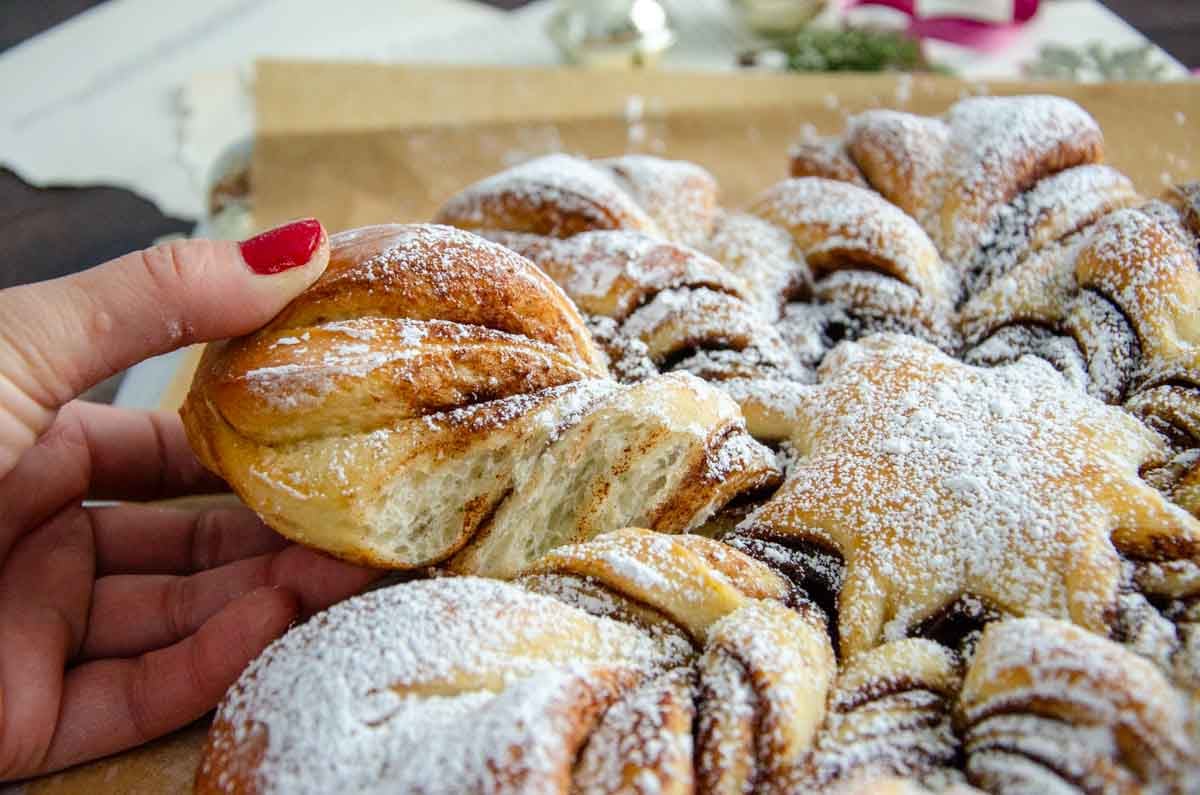
 Welcome to your new favorite baking project that is going to make your kitchen smell like an expensive artisan bakery. This sourdough homemade star bread recipe is all about bringing together the deep, tangy goodness of natural fermentation with the soft, pillowy texture of sweet brioche style dough. Many home bakers feel intimidated when they see a twisted star loaf sitting on a bakery display table because the shape looks like something made by a master pastry chef with decades of experience. In reality, this stunning pastry is made using a remarkably simple layering and twisting technique that anyone can master on their very first try. You simply roll out four circles of sweet sourdough, spread a rich cinnamon sugar and butter filling between the layers, make sixteen easy cuts with a sharp knife, and twist the strips away from each other in pairs. The result is a magnificent, golden brown sixteen pointed star that pulls apart effortlessly into soft, gooey, cinnamon swirled breadsticks. Whether you are a total beginner to wild yeast baking or a seasoned bread maker looking for a fun weekend project, this recipe breaks down every single stage into clear, stress free actions. By using a lively sourdough starter instead of commercial instant yeast, you get a loaf that stays fresh and moist for days without any artificial preservatives. Every single bite delivers a wonderful balance of sweet brown sugar, warm ground cinnamon, rich melted butter, and that subtle, complex sourdough tang that keeps everyone reaching for just one more piece.
There are so many reasons why home bakers and food lovers fall head over heels for this gorgeous braided bread from the very first slice. First and foremost, the visual appeal of a freshly baked star loaf creates an instant reaction of pure joy and amazement whenever you place it on the dining table. People love food that looks like a piece of art, and pulling warm, fluffy petals straight from the center of the loaf makes eating a shared, interactive experience rather than just slicing a regular sandwich bread. Beyond its stunning appearance, the texture of this bread is truly unmatched because the long fermentation process breaks down tough proteins and creates an ultra tender, melt in your mouth crumb. Unlike regular cinnamon rolls that can sometimes feel heavy or overly drenched in sugary frosting, sourdough star bread offers a lighter, airier bite with just the right amount of sweetness in every twist. Families adore gathering around the kitchen counter on slow mornings to tear off warm pieces while sipping hot coffee, tea, or cold milk. Furthermore, the aroma that fills your entire house while this loaf bakes in the oven is pure magic, wrapping every room in cozy notes of toasted butter, caramelized sugar, and sweet spice. Even picky eaters who usually avoid sourdough because they think it tastes too sour will love this recipe because the milk, butter, and sugar mellow out the acidity into a gentle, buttery richness.
Baking a batch of sourdough homemade star bread is also a wonderful choice for both your emotional wellbeing and your physical health goals. From an emotional perspective, working with bread dough by hand is one of the most calming, grounding, and rewarding activities you can do after a busy or stressful week. Mixing the simple ingredients, feeling the smooth dough come together under your palms, and watching wild yeast slowly transform a flat ball of flour into a puffy, living creation brings a deep sense of peace and accomplishment. It is the ultimate celebratory bake for holiday mornings, birthday brunches, winter gatherings, or simply a cozy Sunday when you want to show your loved ones how much you care through homemade food. On the health and fitness side, choosing naturally leavened sourdough over standard store bought sweet pastries offers genuine benefits for your digestion and energy levels. The slow fermentation process allows beneficial lactic acid bacteria and wild yeasts to predigest much of the starches and gluten in the wheat flour, making the bread noticeably gentler on your stomach and easier to absorb. Additionally, natural sourdough fermentation lowers the glycemic response of the bread compared to conventional commercial yeast breads, which means you enjoy steady, sustained energy without a sudden sugar crash right after breakfast. When you bake from scratch at home, you also have total control over the quality of your ingredients, avoiding hidden seed oils, high fructose corn syrup, and chemical dough conditioners found in packaged bakery goods.
Whether you want to impress guests at a festive brunch, create a memorable baking tradition with your kids, or simply treat yourself to a wholesome sweet pastry that supports better digestion, this sourdough star bread checks every single box. You do not need any fancy stand mixers, expensive pastry tools, or professional culinary training to pull off this bakery worthy centerpiece in your own home oven. All you need is a bubbly sourdough starter, basic pantry staples like flour, milk, butter, eggs, and cinnamon, plus a little bit of patience while nature does the heavy lifting during the rise. Throughout this complete guide, I will walk you through every exact measurement, visual cue, and shaping trick so you feel completely confident from start to finish. We will cover how to tell when your dough is properly kneaded, how to prevent your filling from leaking out during baking, and how to achieve that glossy, golden crust that makes every photograph look like a magazine cover. Grab your favorite mixing bowl, preheat your oven when the time is right, and get ready to bake a loaf that your friends and family will talk about for months to come.
Ingredients You Will Need
Gathering and measuring your ingredients before you begin is the easiest way to ensure a smooth, enjoyable baking session. Make sure your dairy ingredients and eggs are at room temperature so they blend smoothly into the dough without chilling your active sourdough starter.
For the Sweet Sourdough Brioche Dough
-
Active Sourdough Starter: 120 grams (about 1/2 cup), fed and bubbly at its peak rise
-
Whole Milk: 180 milliliters (3/4 cup), lukewarm to the touch (around 38 degrees Celsius or 100 degrees Fahrenheit)
-
All Purpose Flour or Bread Flour: 450 grams (about 3 and 1/2 cups), unbleached for the best flavor and structure
-
Unsalted Butter: 60 grams (1/4 cup or 4 tablespoons), softened at room temperature
-
Granulated White Sugar: 50 grams (1/4 cup)
-
Large Egg: 1 whole egg, at room temperature
-
Fine Sea Salt: 7 grams (1 and 1/4 teaspoons)
-
Pure Vanilla Extract: 5 milliliters (1 teaspoon)
For the Cinnamon Sugar Filling
-
Unsalted Butter: 60 grams (1/4 cup or 4 tablespoons), very soft and spreadable
-
Dark Brown Sugar: 100 grams (1/2 cup, packed tightly)
-
Ground Cinnamon: 12 grams (1 and 1/2 tablespoons)
-
Fine Sea Salt: 1 gram (a tiny pinch to balance the sweetness)
For the Egg Wash and Final Garnish
-
Large Egg Yolk: 1 yolk, beaten with 15 milliliters (1 tablespoon) of whole milk
-
Powdered Confectioners Sugar: 25 grams (2 tablespoons) for dusting after baking
Step by Step Method
Follow these simple, chronological instructions carefully. Because sourdough moves at its own gentle pace depending on the warmth of your kitchen, always watch the visual signs of your dough rather than looking strictly at the clock.
Step 1: Feed Your Sourdough Starter
About four to six hours before you plan to mix your dough, feed your sourdough starter with equal weights of flour and water. Keep it in a warm spot on your kitchen counter until it has doubled or tripled in size, looks full of tiny air bubbles, and has a pleasant, slightly sweet and milky smell. Using a starter at its peak strength ensures your sweet dough rises evenly and becomes wonderfully light.
Step 2: Mix the Wet Ingredients
Pour the lukewarm whole milk into a large mixing bowl. Add the bubbly sourdough starter, granulated white sugar, room temperature whole egg, and pure vanilla extract. Use a sturdy whisk or a fork to stir everything together for about one minute until the sourdough starter dissolves into the liquid and the mixture looks creamy and uniform.
Step 3: Add Flour and Salt to Form a Shaggy Dough
Add the flour and fine sea salt directly into the bowl with your wet mixture. Use a wooden spoon, a Danish dough whisk, or your clean hands to stir everything together until no dry pockets of flour remain at the bottom of the bowl. The dough will look a little rough, sticky, and shaggy at this stage, which is completely normal. Cover the bowl with a clean kitchen towel or plastic wrap and let it rest for 30 minutes so the flour can fully absorb the liquid.
Step 4: Knead in the Softened Butter
Uncover your dough and place the softened unsalted butter right on top. Begin squeezing and folding the butter into the dough using your hands, or knead it on a clean countertop for about 8 to 10 minutes. At first, the butter will make the dough feel slippery and messy, so resist the temptation to add extra flour. Keep kneading patiently until the butter is completely absorbed and the dough transforms into a smooth, elastic, soft ball that springs back gently when poked with your finger.
Step 5: Bulk Fermentation (First Rise)
Shape the smooth dough into a tight round ball and place it inside a lightly greased mixing bowl. Cover the bowl tightly so the surface does not dry out, and leave it at room temperature (around 21 to 24 degrees Celsius or 70 to 75 degrees Fahrenheit) for 4 to 6 hours. You want the dough to grow noticeably puffy, airy, and nearly double in volume. If your kitchen is chilly, you can place the bowl inside your turned off oven with just the oven light switched on to create a cozy environment.
Step 6: Chill the Dough for Easy Shaping
Once the dough has doubled in size, gently press it down to release any oversized air bubbles, cover the bowl again, and place it in the refrigerator for at least 1 hour or overnight. Chilling the butter rich dough firms it up, making it much easier to roll into neat circles and cut clean star twists without sticking to your counter.
Step 7: Prepare the Cinnamon Sugar Filling
While the dough chills, combine the packed dark brown sugar, ground cinnamon, and tiny pinch of salt in a small bowl. Stir them together with a fork so there are no brown sugar lumps. Make sure your filling butter is soft enough to spread easily with the back of a spoon or an offset spatula without tearing the rolled dough.
Step 8: Divide and Roll into Four Circles
Take your chilled dough out of the refrigerator and place it on a lightly floured work surface. Use a sharp knife or bench scraper to divide the dough into 4 equal pieces, weighing them on a kitchen scale if you want perfect symmetry. Roll each piece of dough into a neat ball, then use a rolling pin to flatten each ball into a circle measuring about 25 centimeters (10 inches) across.
Step 9: Layer the Dough and Filling
Line a large baking sheet with a piece of parchment paper and lay your first dough circle flat in the center. Spread one third of the softened butter evenly over the surface, leaving a 1 centimeter (half inch) clean border around the outer edge. Sprinkle one third of the cinnamon sugar mixture evenly over the butter. Place the second dough circle directly on top, gently press the edges to align them, and repeat the butter and cinnamon sugar layers. Repeat this one more time with the third dough circle and the remaining filling, then place the fourth dough circle on top as a clean, bare lid.
Step 10: Cut the Sixteen Strips
Place a small drinking glass or round cookie cutter measuring about 6 to 7 centimeters (2.5 to 3 inches) wide gently in the very center of your stacked dough circle to act as a guide. Do not press all the way through; you just want a light circle imprint. Using a very sharp knife or a pizza wheel, slice from the edge of the center circle guide all the way out to the outer edge of the dough to make 4 equal quarters. Next, cut each quarter in half to create 8 equal wedges. Finally, cut each of those 8 wedges in half again so you end up with 16 equal strips radiating out from the uncut center circle.
Step 11: Twist the Strips into a Star
Remove the drinking glass from the center. Pick up two neighboring strips of dough, one in your left hand and one in your right hand. Twist both strips away from each other two full turns, then pinch their outer ends firmly together to form a neat point. Move around the circle and repeat this exact twisting and pinching motion with the remaining pairs of strips until you have 8 gorgeous, twisted star points all the way around your loaf.
Step 12: Second Rise (Final Proof)
Loosely cover the shaped star bread with a clean lightweight towel or greased plastic wrap. Let it rise at room temperature for 1.5 to 2.5 hours until the twists look noticeably puffy, soft, and airy. During the last 20 minutes of rising, preheat your oven to 190 degrees Celsius (375 degrees Fahrenheit) with a rack positioned in the center.
Step 13: Brush with Egg Wash and Bake
Gently brush the top and twisted sides of the risen star bread with the beaten egg yolk and milk mixture, taking care not to deflate the delicate dough. Place the baking sheet into the preheated oven and bake for 22 to 26 minutes until the crust turns a rich, deep golden brown and the internal temperature reaches 88 degrees Celsius (190 degrees Fahrenheit). If the top browns too quickly around the 15 minute mark, loosely tent a piece of aluminum foil over the loaf for the remaining minutes.
Step 14: Cool Slightly and Dust with Sugar
Remove the baked star bread from the oven and let it rest on the baking sheet for 10 to 15 minutes so the melted cinnamon sugar settles and thickens slightly. Dust the warm loaf generously with powdered confectioners sugar using a fine mesh sieve, then serve warm right away while the layers are soft and gooey.
Why This Recipe Is Special
There are countless sweet bread recipes available online, yet sourdough homemade star bread stands in a league of its own for flavor, nutrition, and baking satisfaction. Here is what makes this particular loaf truly remarkable compared to standard bakery pastries:
-
Deep, Balanced Flavor Profile: Commercial cinnamon bread often tastes one dimensional because fast acting yeast adds very little aroma of its own. Natural sourdough fermentation produces complex organic acids and aromatic compounds during the long rise, creating a subtle, buttery depth that balances the sweetness of dark brown sugar and warm cinnamon.
-
Gentle on Your Digestive System: During the hours of bulk fermentation and cold proofing, wild yeasts and healthy bacteria break down complex starches and phytic acid in the flour. Many people who feel bloated or heavy after eating conventional white bread find that naturally fermented sourdough feels light, comfortable, and easy to digest.
-
Steadier Blood Sugar Response: Because natural fermentation alters the starch structure of wheat flour, sourdough bread generally has a lower glycemic index than bread made with commercial baker’s yeast. Pairing slow fermented grains with protein from milk and eggs helps provide steady energy without sudden spikes and crashes.
-
No Need for Heavy Frosting: Traditional cinnamon rolls rely on thick layers of cream cheese icing to stay moist and flavorful. Because this star bread weaves thin ribbons of caramelized butter and brown sugar throughout sixteen twisted strands, every single bite is naturally moist, rich, and sweet on its own.
-
Longer Natural Shelf Life: The natural acidity present in sourdough acts as a gentle, built in preservative that slows down staling and keeps the crumb soft for days. Even two days after baking, a quick ten second warm up brings the bread right back to its fresh from the oven softness.
-
Built In Portion Control and Sharing: Instead of needing a bread knife and plates, guests can simply pull off individual twisted points with their fingers. Each point is a neat, satisfying serving that encourages slow, mindful eating around the table.
Extra Tips for Better Taste
Once you master the classic cinnamon sugar version, you can easily customize your sourdough star bread to match different seasons, cravings, and flavor profiles. Try these creative upgrades to make your loaf even more delicious:
-
Brown the Butter First: Before making your filling, melt the butter in a small saucepan over medium heat until the milk solids turn golden brown and smell nutty and toasted. Let the brown butter cool back down to a soft, spreadable paste before mixing it with the brown sugar and cinnamon for an unforgettable caramel flavor.
-
Add Fresh Orange or Lemon Zest: Rub the fresh zest of one bright orange directly into your dark brown sugar with your fingertips before spreading the filling. The citrus oils wake up the warm cinnamon spice and add a refreshing bakery aroma that pairs wonderfully with morning coffee.
-
Try a Rich Chocolate Hazelnut Swirl: Swap the butter, brown sugar, and cinnamon filling for a thin, even layer of smooth chocolate hazelnut spread mixed with finely chopped toasted hazelnuts. Chill the layered circle for 15 minutes before slicing so the chocolate stays neat while you twist the strips.
-
Infuse Warm Cardamom and Nutmeg: Replace half a teaspoon of the ground cinnamon with freshly ground green cardamom and a pinch of grated nutmeg. Cardamom adds a fragrant, floral warmth popular in Scandinavian sweet buns that elevates the sourdough tang beautifully.
-
Brush with Warm Maple Glaze: Right as the bread comes out of the oven, brush the hot golden crust with a thin layer of pure maple syrup instead of dusting with powdered sugar. The heat caramelizes the maple syrup instantly, giving your star bread a gorgeous glossy shine and a hint of woodsy sweetness.
-
Use High Quality Ceylon Cinnamon: Standard grocery store cinnamon is bold and spicy, whereas Ceylon cinnamon is delicate, sweet, and slightly floral. Using Ceylon cinnamon gives your star bread a refined, gourmet pastry shop flavor that lets the buttery sourdough shine through.
Final Thoughts
Baking sourdough homemade star bread from scratch is one of those rare kitchen projects that looks wildly impressive while remaining completely achievable for everyday home cooks. From the quiet joy of mixing your bubbly wild starter into warm milk to the exciting moment you pull a golden, twisted star out of the oven, every step connects you to the timeless craft of real bread baking. Do not worry if your very first star has slightly uneven points or a little bit of cinnamon sugar peeking out from the twists, because rustic homemade charm is part of what makes artisan baking so wonderful. Whether you serve this warm loaf for a holiday breakfast, bring it to a neighborhood potluck, or tear off a sweet cinnamon point on a quiet weekend afternoon, it is guaranteed to bring smiles to everyone who tastes it. Keep your starter fed, trust your hands, and enjoy the wonderful smell of fresh sourdough filling your home.
Nutrition Details
The following nutrition estimates are calculated for the entire recipe as well as for one individual serving, assuming the star bread is divided into 16 equal pull apart portions. Values may vary slightly depending on the specific brands of flour, butter, and milk you choose to use.
| Nutrient | Entire Recipe (1 Loaf) | Per Serving (1 of 16 Twists) |
| Calories | 3,360 kcal | 210 kcal |
| Total Carbohydrates | 496 g | 31 g |
| Dietary Fiber | 16 g | 1 g |
| Total Sugars | 160 g | 10 g |
| Protein | 64 g | 4 g |
| Total Fat | 120 g | 7.5 g |
| Saturated Fat | 72 g | 4.5 g |
| Cholesterol | 560 mg | 35 mg |
| Sodium | 2,880 mg | 180 mg |
Disclaimer
Please remember that every person’s body, digestive system, and nutritional needs are unique, so individual results and reactions to any food or recipe may vary. The nutritional figures provided in this article are general estimates calculated from standard ingredient databases and should not be taken as strict medical or dietary advice. If you have specific health conditions, food allergies, gluten sensitivities, or blood sugar management goals, please consult a qualified healthcare professional or registered dietitian before making changes to your daily eating habits.