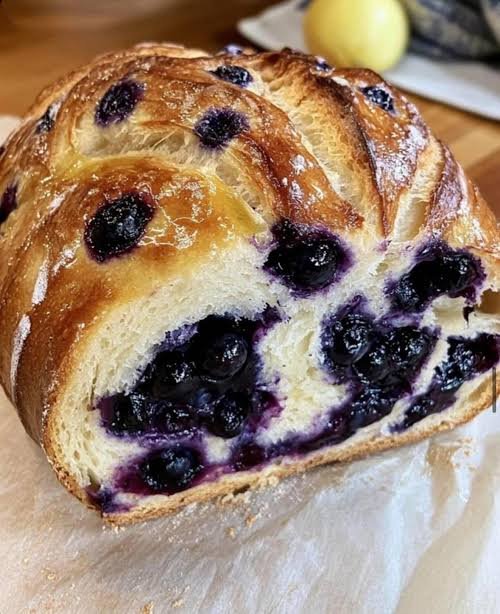
Freshly baked bread brings a special kind of comfort into any home kitchen, especially when it combines traditional baking methods with bright, sweet flavors. Blueberry Lemon Cream Cheese Sourdough is a delightful artisan loaf that blends the natural tang of wild fermentation with sweet juicy berries, zesty citrus, and rich velvety cream cheese. Making this bread is a wonderful journey that turns basic kitchen ingredients like flour, water, salt, and sourdough starter into a impressive masterpiece that looks like it came straight from a cozy European bakery. The contrast of textures makes every bite exciting because you get a crispy outer crust alongside a soft interior packed with rich swirls. Bakers of all skill levels enjoy crafting this sourdough loaf because it allows them to experiment with sweet additions inside a traditional savory structure. The vibrant purple and blue pockets of fruit against the golden baked crust create a visually stunning loaf that brightens up any kitchen counter.
People absolutely fall in love with this recipe because it balances contrasting flavor profiles in a way that feels indulgent yet balanced. The natural acidity of the sourdough starter complements the bright citrus notes of lemon zest, while the creamy texture of the cream cheese cuts through the tartness of fresh blueberries. Many home bakers appreciate how the sweetened cream cheese melts slightly during the baking process, creating silky pockets throughout the crumb that keep the bread moist for days. Children and adults alike enjoy this loaf because it tastes like a gourmet breakfast pastry while maintaining the satisfying texture of homemade sourdough bread. It also makes your whole home smell amazing while it bakes, filling every room with warm scents of toasted grains, caramelized berries, and baked vanilla. Sharing a warm slice of this bread with family or friends creates instant happiness, making it a beloved favorite for weekend baking projects and special gatherings.
This recipe is ideal to make whenever you want to elevate a morning routine or celebrate a quiet weekend at home with loved ones. It fits perfectly into a relaxed Sunday brunch menu alongside warm coffee, fresh tea, or chilled juice, serving as a delicious centerpiece that impresses your guests. From a emotional perspective, baking this bread offers a peaceful and rewarding way to slow down, practice mindfulness, and enjoy the physical process of working with dough by hand. Taste wise, it satisfies sweet cravings without relying on excessive refined sugar, making it a smarter alternative to store bought donuts or heavily processed morning pastries. From a fitness and wellness viewpoint, traditional sourdough fermentation helps break down gluten and phytic acid, making the grains much easier on your digestive system compared to standard quick yeast breads. The natural energy from quality carbs, antioxidant rich blueberries, and wholesome fats provides sustained stamina for busy mornings or active afternoons.
Whether you are looking for a unique centerpiece for a holiday breakfast, a creative weekend project, or a delicious snack to share, this loaf fits every occasion perfectly. Baking with a living sourdough starter connects you to ancient culinary traditions, giving you a deep sense of accomplishment once you slice into the finished product. The combination of fruity sweetness and rich cream cheese turns ordinary toast into an extraordinary treat that requires no extra jams or spreads to enjoy. Kids love helping mix the sweet filling, while adults appreciate the complex flavor layers created by the long overnight cold fermentation process in the refrigerator. Every single step of the process, from feeding your active starter to watching the loaf rise inside a hot oven, offers simple kitchen joy. Once you experience the smell of fresh lemon zest and warm blueberries wafting from your oven, this unique sourdough variation will quickly become a regular request in your household.
Ingredients You Will Need
To create this wonderful artisan loaf, you will need to gather ingredients for both the main sourdough bread base and the delicious sweet filling. Measuring your ingredients accurately using a digital kitchen scale will ensure the best possible results.
Main Sourdough Dough Ingredients
-
Active sourdough starter (bubbly and fed): 100 grams
-
Bread flour (high protein flour): 450 grams
-
Whole wheat flour (for extra depth): 50 grams
-
Filtered water (slightly warm): 350 grams
-
Fine sea salt or kosher salt: 10 grams
-
Fresh lemon zest (from one organic lemon): 5 grams
Blueberry Lemon Cream Cheese Filling Ingredients
-
Cream cheese (softened at room temperature): 150 grams
-
Powdered sugar or organic cane sugar: 30 grams
-
Pure vanilla extract: 5 grams
-
Fresh lemon zest (for filling layer): 5 grams
-
Fresh blueberries (washed and completely dried): 120 grams
-
Cornstarch (to coat the blueberries): 10 grams
Step by Step Method
Creating this artisan loaf is a rewarding process that relies on simple techniques, patience, and gentle handling. Follow these clear steps to bake your own magnificent blueberry lemon sourdough bread.
Step 1: Prepare Your Active Starter
Make sure your sourdough starter is active and energetic before beginning your dough. Feed your starter about four to six hours before mixing your dough so it doubles or triples in size and becomes full of airy bubbles. You can test readiness by dropping a tiny spoonful of starter into a cup of room temperature water. If it floats near the top, your starter is ready to bake great bread.
Step 2: Mix Water, Starter, and Flours
In a large clean glass or ceramic mixing bowl, combine 350 grams of warm filtered water with 100 grams of your active sourdough starter. Stir gentle using a wooden spoon or a dough whisk until the starter dissolves completely into a milky liquid. Add 450 grams of bread flour and 50 grams of whole wheat flour into the liquid mixture. Mix thoroughly until all dry bits of flour vanish and a shaggy dough forms. Cover the bowl with a clean damp kitchen towel and let it rest for 45 minutes. This important resting period is called autolyse, which helps the flour hydrate fully and starts gluten development effortlessly.
Step 3: Add Salt and First Lemon Zest
After the resting period ends, sprinkle 10 grams of fine sea salt and 5 grams of fresh lemon zest evenly across the top of your dough. Dimple the salt and zest into the dough using wet fingers, then gently fold the dough over itself several times until everything is fully incorporated. Cover the bowl again and let it rest for 30 minutes in a warm spot in your kitchen.
Step 4: Perform Stretch and Folds
Over the next two hours, you will perform four sets of stretch and folds spaced 30 minutes apart. To perform a fold, wet your hands with clean water to prevent sticking. Reach down to the bottom of the bowl, grab one side of the dough, stretch it upward gently without tearing it, and fold it over the top toward the center. Rotate the bowl ninety degrees and repeat this action on all four sides. Cover the dough between each set. You will notice the dough becoming smoother, stronger, and more elastic after every set.
Step 5: Prepare the Sweet Cream Cheese Filling
While your dough rests during its bulk fermentation, prepare your delicious filling ingredients. In a small mixing bowl, beat 150 grams of softened cream cheese, 30 grams of sugar, 5 grams of vanilla extract, and 5 grams of fresh lemon zest until smooth and creamy. In a separate small bowl, toss 120 grams of fresh dry blueberries with 10 grams of cornstarch until each berry is lightly coated. The cornstarch helps absorb excess moisture from the blueberries so your bread does not become soggy while baking.
Step 6: Bulk Fermentation
Allow the folded dough to sit undisturbed at warm room temperature until it rises by roughly fifty percent in volume, feels light, and shows visible air bubbles on the surface. Depending on your room temperature, this bulk fermentation stage usually takes between three and five hours.
Step 7: Laminate and Add Fillings
Lightly mist your clean kitchen counter with water or flour. Gently tip your fermented dough out onto the surface. Using wet or lightly floured hands, carefully stretch the dough outward into a large, thin rectangular shape, taking care not to tear the delicate gluten structure. Spread the prepared cream cheese mixture evenly across the surface of the stretched dough, leaving a small border around the edges. Sprinkle the cornstarch coated blueberries evenly over the cream cheese layer.
Step 8: Shape the Artisan Loaf
Fold one third of the dough rectangle over into the center, then fold the opposite third over the top, just like folding a letter. Roll the long strip up tightly from the bottom edge to create a neat cylinder shape. Gently tuck the sides under to form a smooth round ball or oval shape, sealing any open seams. Let the shaped dough rest uncovered on your counter for 15 minutes to build surface tension.
Step 9: Transfer to Banneton for Cold Fermentation
Dust a round or oval sourdough proofing basket (banneton) generously with rice flour or bread flour. Using a bench scraper, carefully lift your shaped dough and place it upside down into the prepared proofing basket, seam side facing up. Cover the basket securely with a plastic bag or shower cap. Place the basket into your refrigerator for a cold overnight fermentation lasting between 12 and 16 hours. This slow cold rest develops complex sourdough flavor and firms up the cream cheese filling.
Step 10: Preheat Your Oven and Dutch Oven
The next morning, place a heavy Dutch oven with its lid inside your oven. Preheat your oven to 450 degrees Fahrenheit (230 degrees Celsius) for a full 45 minutes to one hour so the pot becomes piping hot.
Step 11: Score and Bake
Remove your sourdough basket from the refrigerator. Place a sheet of parchment paper over the top of the basket, invert the basket onto your counter, and gently remove the basket. Dust the top of the dough lightly with flour. Using a sharp razor blade or baker lame, cut a deep slash across the top of the loaf to allow steam to escape during baking. Carefully lift the loaf using the parchment paper edges and lower it into your hot Dutch oven. Drop two small ice cubes under the parchment paper to create extra steam, then quickly place the lid on top.
Step 12: Bake to Perfection
Bake with the lid covered for 20 minutes at 450 degrees Fahrenheit (230 degrees Celsius). After 20 minutes, carefully remove the lid, drop the oven temperature to 400 degrees Fahrenheit (200 degrees Celsius), and continue baking uncovered for another 20 to 25 minutes. The crust should turn a deep golden brown color, and the blueberry juice will bubble pleasantly along the scored top.
Step 13: Cool Completely
Carefully lift the baked sourdough loaf out of the hot Dutch oven and place it onto a wire cooling rack. Allow the bread to cool completely at room temperature for at least two to three hours before slicing. Slicing warm bread with cream cheese inside can cause the crumb to become gummy, so patience pays off with perfect slices.
Why This Recipe Is Special
This unique recipe combines culinary beauty, incredible flavor balance, and health benefits into a single artisan loaf. Unlike simple plain sourdough, this variation offers a complete sensory experience that elevates standard home baking into a gourmet art form.
First, the taste profile of this bread is truly extraordinary. The natural acidity produced by slow wild yeast fermentation interacts beautifully with bright citrus oils from fresh lemon zest. Meanwhile, the rich cream cheese provides a smooth, decadent texture that tempers the natural sour notes of the dough. The sweet blueberries burst open inside the hot loaf during baking, creating natural jam pockets that make every single slice feel special and flavorful without needing extra toppings.
Second, the health advantages of sourdough fermentation make this treat easier on digestion than conventional baked goods. During the long fermentation process, beneficial wild yeasts and lactic acid bacteria break down complex starches and phytic acid found naturally in wheat flour. This process makes essential nutrients and minerals like iron, zinc, and magnesium much easier for your body to absorb. Furthermore, the slow fermentation reduces gluten structures slightly, which many people find gentler on their stomach compared to quick yeast breads.
Finally, blueberries are packed with powerful antioxidants, vitamin C, and fiber, adding natural nutritional value to your morning meal. Using real lemon zest supplies fresh citrus compounds that boost mood and support digestion. By making this bread from scratch at home, you maintain total control over your ingredients, completely avoiding the artificial preservatives, dough conditioners, hydrogenated oils, and high fructose corn syrup commonly found in commercial bakery products.
Extra Tips for Better Taste
To achieve bakery quality results in your home kitchen, keep these helpful creative tips in mind while preparing your loaf:
-
Use fresh organic lemons instead of bottled lemon juice because the aromatic oils in the peel hold the maximum amount of vibrant citrus flavor.
-
Always dry your blueberries thoroughly after washing them because excess water will create wet pockets and cause the dough to get mushy.
-
Swap fresh blueberries for high quality frozen blueberries if fresh ones are out of season, but do not thaw frozen berries before tossing them in cornstarch.
-
Add a small pinch of ground cinnamon or cardamom to the cream cheese mixture if you want to create a warm autumn flavor twist.
-
Rice flour works best for dusting your proofing basket because it contains no gluten and prevents sticky dough from adhering to the basket walls.
-
Ensure your cream cheese is completely softened at room temperature before mixing so it spreads smoothly without tearing your delicate dough layer.
-
Slice your finished loaf using a sharp serrated bread knife to get clean, crisp slices without squishing the soft cream cheese pockets.
-
Store leftover slices wrapped in parchment paper inside an airtight container in your refrigerator for up to five days, or freeze individual slices for quick weekday toasts.
Final Thoughts
Baking your own Blueberry Lemon Cream Cheese Sourdough is one of the most rewarding culinary experiences you can enjoy at home. The process combines simple, honest ingredients with time honored fermentation methods to create a loaf that satisfies both your hunger and your creative spirit. Each step, from feeding your active starter to scoring the chilled loaf, brings a sense of mindfulness and joy into your kitchen routine. Slicing into a fresh loaf reveals beautiful purple berry swirls, rich cream cheese pockets, and a soft, airy crumb surrounded by a golden crispy crust. It makes a thoughtful gift for neighbors, a delightful addition to family brunch tables, and an easy way to turn an ordinary morning into a special occasion. Take your time, enjoy the rhythmic process, and celebrate the incredible flavors of fresh homemade sourdough bread.
Nutrition Details
Here is an estimated nutrition breakdown for this Blueberry Lemon Cream Cheese Sourdough recipe. Values are calculated for the full recipe loaf as well as per individual serving based on ten equal slices.
Recipe Nutrition Overview Table
| Nutrient Category | Total Full Loaf | Per Serving (1 Slice) |
| Calories | 2450 kcal | 245 kcal |
| Carbohydrates | 410 g | 41 g |
| Dietary Fiber | 18 g | 1.8 g |
| Sugars | 45 g | 4.5 g |
| Total Fat | 65 g | 6.5 g |
| Saturated Fat | 38 g | 3.8 g |
| Protein | 58 g | 5.8 g |
| Sodium | 3900 mg | 390 mg |
| Calcium | 220 mg | 22 mg |
| Iron | 14 mg | 1.4 mg |
The values listed above demonstrate that this sourdough variation provides a well rounded balance of complex carbohydrates for lasting energy, healthy fats from quality dairy, and modest protein levels. Enjoying a slice along with a source of lean protein or eggs creates a balanced morning meal.
Disclaimer
This recipe article is created for informational, educational, and culinary enjoyment purposes only. Nutritional calculations are estimates based on standard ingredient databases and may vary depending on specific brands, exact measurements, or modifications used in your own kitchen. Everyone has unique dietary requirements, metabolism speeds, and health conditions, meaning physical responses to food and fermentation products will naturally vary from person to person. If you have severe dairy allergies, gluten sensitivities, celiac disease, or specific metabolic health conditions, please consult with a qualified medical healthcare professional or registered dietitian before incorporating new recipes into your regular meal routine.